
Locations
Step into the Realm of Vaedanys, a land where the mystical and the mortal intertwine. From its sky-piercing crystal spires to its shadow-choked underlands, Vaedanys is a world alive with magic, history, and peril. Shaped by forgotten gods and scarred by ancient wars, every corner of this world holds a story waiting to be uncovered.


Aegan Empire
The Aegan Empire stands as a testament to human ambition, resilience, and conquest. Sprawling across a vast stretch of war-hardened lands, it is ruled by a long line of human emperors whose legacies are etched in blood and iron.
For centuries, the Empire has been both unifier and oppressor—rising from a patchwork of feuding kingdoms through relentless military campaigns and political machinations. Bordering nations speak the Aegan name with both reverence and dread, for its banners often arrive alongside legions.
Though peace has come in seasons, the Empire’s history is steeped in conflict: from civil wars and dynastic purges to brutal campaigns against rival realms and rebellious provinces. Its people are forged by strife, its cities fortified by necessity, and its culture shaped by the scars of conquest. Today, the Aegan Empire stands proud and vigilant—scarred, but unbroken.
Population: Mostly Human, some Draconian, some Goblin, partly Elf, partly Dwarf, partly Ferroxylon, little Syreni. Monster races are attacked, captured or killed.

Kingdom Of Knaak
The Kingdom of Knaak rises from the heart of the Scorching Expanse, a brutal and majestic desert realm ruled by the beastlike Minotaurs—towering, horned creatures of immense strength and ruthless will. Emulating the grandeur and divine order of ancient kingdoms, Knaak’s society is rigidly stratified, with its god-kings—known as Pharaohs of the Horned Sun—believed to be divine avatars chosen to wield power over beast and man alike.
Life beneath the burning sun is harsh, and so is the rule of Knaak. Slavery is not just an institution but a cornerstone of civilization, with vast labor forces—comprised of conquered peoples, criminals, and the unfortunate—erecting monolithic tombs, carving temple-cities into canyon walls, and harvesting life from barren soil. Power is asserted through fear, grandeur, and ritual, with public punishments and ceremonial battles reinforcing the Minotaur elite's dominance.
Yet there is an undeniable beauty to the kingdom’s cruelty: obsidian statues that stare unblinking into eternity, ancient glyphs that tell tales of celestial wars, and cities where blood and gold flow with equal weight. Foreigners are tolerated only when useful, and diplomacy often masks a hunger for expansion or subjugation.
Population: Mostly Minotaur, some Goblin, some Pryad partly Miyavi, partly Draconian, partly Infernal, partly Honu, little Goliath. Monster lineages are shown caution.


Protectorate Of Kador
The Protectorate of Kador is a land of towering majesty and ancient strength, nestled among the awe-inspiring Silver Mountains—the tallest and most treacherous range in the known world. Here, the earth scrapes the sky, and thunder speaks louder than kings. Governed not by a singular monarch, but by a council of chieftains and war-sages, Kador exists as a loose protectorate—united in defense, but fiercely independent in spirit.
Its people are primarily giant-kin—descendants of the old titans, standing well above the height of common folk, with deep ties to storm and stone. Alongside them dwell resilient nomadic tribes, known for their skill in navigating the mountain passes and their unmatched ability to survive in the high altitudes and bitter cold. These nomads are traders, storytellers, and warriors, bonded by tradition and clan oaths older than written word.
Kador’s society values strength, honor, and freedom. While not aggressive by nature, its warriors are feared for their ferocity in battle and their ability to call upon the mountain spirits in times of war. Outsiders are met with wary respect—those who come in peace find hospitality and highland wisdom, while those who come with ill intent vanish into the snow-choked passes.
Population: Mostly Goliath, some Imedus, some Orc, partly Pryad, partly Ferroxylon, partly Lowenar, little Minotaur, little Honu. Monster lineages are attacked and killed.
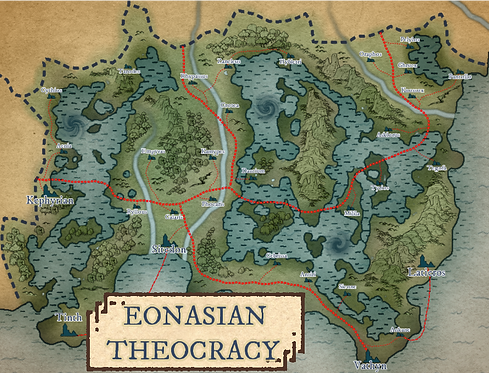
Eonasian Theocracy
The Eonasian Theocracy lies beneath and along the vast cerulean coasts of the Eastern Reach, a realm where the land kisses the ocean—and the ocean rules in return. Its people are predominantly aquatic races, chief among them the Syreni: sleek, amphibious beings of otherworldly grace, known for their haunting voices and mastery over currents both physical and magical.
Eonasia is more than a nation—it is a sacred dominion, governed by the will of the Lords of the Deep, a powerful and enigmatic pantheon said to dwell in the darkest trenches of the world’s oceans. The theocracy is ruled by the High Tide Ecclesia, a council of tide-priests, oracles, and deep-seers who interpret the will of the gods through signs in the sea, shifting tides, and the dreams of the drowned. Rituals, sacrifices, and song-magic shape daily life, all devoted to maintaining the sacred balance between surface and abyss.
The architecture of Eonasia flows with the sea: coral spires, submerged temples, and cities that blur the lines between land and water. Foreigners may find the culture alien and the laws opaque, for the will of the Deep is not easily understood—and disobedience is said to awaken things best left sleeping.
Population: Mostly Syreni, some Sauri, some Pryad partly Dwarf, partly Human, partly Gnome, little Elf. Monster lineages are shown caution.

Republic Of Kalesh
The Republic of Kalesh is a land of grace and precision, where ancient tradition dances with refined governance. Spanning fertile river valleys, mist-laced bamboo forests, and majestic highland terraces, its landscape evokes the elegance and grandeur of old dynasties. Though it is a republic in name, Kalesh reveres order and hierarchy—its Senate of Clans composed of noble houses, warrior-philosophers, and mystics whose voices shape the destiny of the realm.
The people of Kalesh are a vibrant blend of races, yet it is the Lowenar, the Lionfolk—regal, disciplined, and deeply philosophical—who serve as the cultural and political heart of the nation. With their flowing manes and commanding presence, the Lowenar see themselves as guardians of harmony and exemplars of virtue, following a code that blends martial discipline, scholarly pursuit, and spiritual clarity.
Kalesh places immense value on balance—between mind and body, nature and civilization, duty and honor. From the soaring pagodas of its capital to the silent monasteries carved into mountain cliffs, the Republic thrives on tradition and innovation alike. Art, alchemy, astronomy, and martial arts flourish here, alongside a powerful military that defends its borders with elegance and fury.
Population: Mostly Lowenar, partly Vulpine, some Human partly Dwarf, partly Draconian, partly Undead, partly Hybrid, little Minotaur, little Orc. Monster lineages are shown caution.
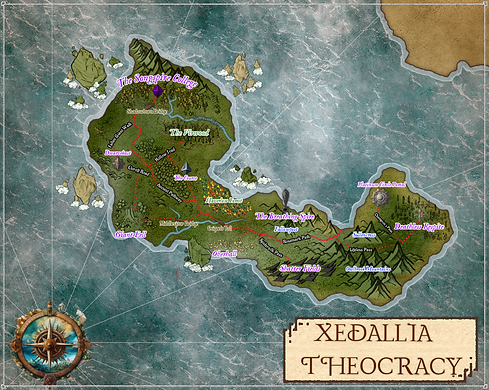
Xedallia Theocracy
The Xedallia Theocracy is a land of sublime mystery and arcane reverence, founded by the most powerful mages to ever walk the mortal world—those who once played a part in the Cataclysm, the war of magic so vast it tore the ancient world into fragments. Shamed or enlightened by the devastation they helped unleash, these archmagi withdrew from worldly ambition and raised a land of their own, consecrated in the name of Xedall, goddess of wisdom, knowledge, and the eternal pursuit of truth.
The realm they created is one of towering spires, floating citadels, and libraries the size of cities. From the sanctums of the Magi, the ruling council of archmagi, the Theocracy is governed not by blood or gold, but by enlightenment, scholarship, and strict adherence to The Tenets of Knowing—divine laws said to have been whispered by Xedall herself to the first magister-priests.
Magic in Xedall is not merely a tool but a sacred language, a bridge between mortal minds and divine thought. Every citizen is expected to study, to contemplate, and to offer their mind to the greater understanding. Though the ruling class consists almost entirely of ancient or ascended mages, their authority is tempered by religious devotion and the constant reminder of the cataclysm they helped cause.
The land itself is both wondrous and treacherous—shimmering with magical residue, anchored by leyline hubs, and dotted with anomalies from spells long forgotten or too complex to unravel. While the theocracy is largely isolationist, it sends out emissaries, scholars, and seers in service of Xedall’s will—seeking knowledge to preserve, protect, or lock away.
Population: Mostly Mages of all races. some Undead, Monster lineages treated equally.

Iamovar Empire
The Iamovar Empire is a realm of ancient beauty and quiet power, ruled by a coalition of noble elven clans whose lineages stretch back to the dawn of recorded time. Spanning vast, enchanted forests, crystal rivers, and misted hills, the empire is as much a spiritual homeland as it is a political entity—woven together by shared ancestry, arcane tradition, and a reverence for the natural world.
Each ruling clan holds dominion over a region of the empire, maintaining autonomy while swearing fealty to the High Throne of Iamovar, an ancient seat held by the Firstblood Line—a family said to be chosen by the stars themselves. Though most inhabitants are elves of varying heritages—high, wood, dusk, and others—the empire is home to reclusive gnomes and mysterious Ciern, fey-touched beings who dwell in the shaded groves and stone-carved hill homes, often keeping their distance from elven politics.
Magic is woven into every aspect of Iamovar life—its cities glow with living crystal, its roads sing with ancient enchantments, and its nobility engages in courtly intrigue as graceful as it is lethal. The empire values art, scholarship, and preservation, yet its military, composed of spellblades and rangers, is swift to rise when the sanctity of their lands is threatened.
Population: Mostly Elf, some Gnome, some Goblin, partly Pryad, partly Ciern, partly Gort, little Human. Monster lineages are shown caution.
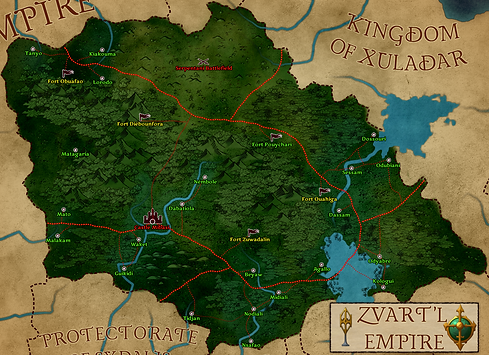
Zvart'l Empire
The Zvart’l Empire is a realm of deep scars and slow healing, once dominated by the proud and agile Miyavi, a feline race known for their artistry, agility, and spiritual harmony with the natural world. For centuries, the Miyavi ruled the empire’s sun-dappled jungles and misty stone cities—until their golden age was shattered by the rise of the Serpentari, a cunning and serpentine race who seized power through conquest and sorcery.
Under Serpentari rule, the Miyavi were enslaved and scattered, their temples desecrated and their culture suppressed. It was not until the rise of Queen Xal'ithara the Kind-Hearted, a rare voice of compassion among the Serpentari, that the chains were broken. In an unprecedented act of clemency, she freed the Miyavi, granting them their lives and dignity—but by then, the damage had been done. The Miyavi, unwilling to return to centralized rule, splintered into nomadic tribes and hidden enclaves, seeking solace in forgotten sanctuaries and the remote corners of the empire.
Today, the Zvart’l Empire is a tense tapestry of cultures: Serpentari dynasties maintain political control from obsidian palaces and step-pyramids, while Miyavi tribes trade, wander, or protect sacred groves in the wilds. Amid them dwell the enigmatic Ciern, sentient tree-like beings who claim to predate both serpent and catfolk, living as patient observers and quiet caretakers of ancient places.
The empire itself spans steaming rainforests, marshy river deltas, and vine-strangled ruins—its roads overgrown, its borders ever-shifting. Though Queen Xal'ithara's reforms brought a fragile peace, resentment and distrust still simmer beneath the surface, and some whisper of Miyavi warriors preparing to reclaim what was once theirs.
Population: Mostly Miyavi, Mostly Serpentary, some Human, partly Undead, partly Goblin, partly Infernal, partly Changeling, partly Gort, little Stakor, little Arachnari, little Vargheist. Monster lineages are treated equally.

Grand Duchy Of Faversham
The Grand Duchy of Faversham stands as a rare and shining anomaly in a world marred by fear, conquest, and division. Tucked between protective mountain ranges and rolling emerald plains, Faversham is a sanctuary realm—a place where all peoples, from noblefolk to the so-called monstrous races, are offered protection, dignity, and a place to call home.
Founded generations ago by Duke Harven the Wise, a human noble who defied the edicts of his own empire to offer refuge to outcast kin, Faversham has since flourished into a diverse and fiercely independent duchy. Orc till the fields, Infernal serve on councils, goblins run merchants’ guilds, and Vargheist tend ancient libraries. No race is turned away so long as they uphold the duchy’s laws—chief among them: respect all, defend the peace, and judge none by blood alone.
The land is as varied as its people: highland keeps, deep caves turned to cities, sylvan woods humming with fey energy, and multicultural marketplaces where beastkin, undead, elves, and humans walk side by side. Magic and technology coexist, and every race contributes something vital to the patchwork harmony that defines the duchy.
Population: Mostly Human, several other races both non-monster and monster lineages present.
Principality Of Hildenfell
The Principality of Hildenfell is a land of tranquil beauty and noble heritage, where rolling hills, lush forests, and golden grasslands stretch beneath wide, open skies. Once a frontier province of the Iamovar Empire, Hildenfell gained semi-independence generations ago, ruled now by a princely bloodline descended from an Iamovari noble house. Though culturally elven at its core, Hildenfell has developed its own identity—grounded, pastoral, and fiercely proud.
The ruling Prince of Hildenfell, known as the Verdant Sovereign, holds both ancestral authority and personal charisma, balancing traditional elven customs with the pragmatism needed to rule a diverse and rural population. While the nobility maintain ties to Iamovar’s arcane sophistication, life in Hildenfell is simpler, more connected to the rhythms of the land. Druids, wardens, and rangers walk openly among the people, maintaining harmony between civilization and the wild.
The population includes a mix of elves, half-elves, humans, and forestfolk—drawn to the region’s gentler climate, fertile soil, and sense of shared purpose. The Principality is known for its skilled bowyers, herbalists, and riders, as well as its unique blend of courtly tradition and frontier resilience.
Population: Mostly Elf, some Human, partly Gort, partly Ciern, partly Stakor, little Serpentari, little Ferroxylon. Monster lineages are shown caution.


Chained Marches
The Chained Marches is a defiant land born not from nobility or divine right, but from blood, fire, and sheer will. Nestled within a scarred expanse where countless battles were once waged between the Zvart’l Empire and the Grand Duchy of Faversham, the Marches began as nothing more than a chain of grim prison camps and forced labor sites, where captured soldiers, war criminals, and so-called undesirables from both sides were cast into the dust to be forgotten.
But they did not remain forgotten for long.
Over decades, the prisoners—hardened, furious, and united only by their suffering—turned chains into weapons and cages into fortresses. In a series of brutal revolts now known as the 'Chained March' where its name derived from, they overthrew their captors, razed the camps, and claimed the battlefield itself as their own. From the ashes of war, the Chained Marches was born: a duchy without nobility, where freedom is sacred, and strength is law.
Now a rough but fiercely independent realm, the Marches are ruled by a council of warlords and former prisoners, known as the Iron Assembly, where every voice carries weight according to deeds and scars earned. Its people are a mix of exiles, mercenaries, former slaves, and outcasts—orc, human, beastkin, dark elves, and even defectors from the empires that once warred over them.
Population: Mostly Human, partly Elf, partly Dwarf, partly Goblin, partly Minotaur, partly Lowenar. Monster Lineages are attacked and captured or killed.
Protectorate Of Sydalis
The Protectorate of Sydalis is a land steeped in myth, memory, and the silent watching of ancient things. A territory under the nominal rule of the Zvart’l Empire, Sydalis remains largely autonomous—guarded as a sacred region due to the presence of The Great Oak, a colossal, world-tree whose golden leaves shimmer with divine resonance. Said to have been the first tree planted by the Old Gods, the Great Oak is not just a wonder of nature, but a living relic of creation—its roots stretching deep into the soul of the land.
Sydalis is a realm of verdant groves, still waters, and eternal green, but also one of deep, layered history. It is the ancestral home of the Sauri, a proud race of lizardfolk once subjugated by a mystical ruling caste known as the Aetheos—cruel tyrants who wielded psychic power and ruled with cold detachment. After a great uprising, the Aetheos were overthrown and driven to the Wake, a cluster of floating islands that hover like broken halos above Sydalis. From their lofty sanctuaries, they watch still, distant and diminished, but not forgotten.
Now freed, the Sauri live in harmony with the land and the Great Oak, forming tribal communities guided by druidic seers and warrior-priests who protect the sacred roots from corruption and imperial overreach. Alongside them dwell the Gort, a race of amphibious, frog-like humanoids who thrive in Sydalis’s wetlands and marshes. Tricksters, artisans, and swamp-wise mystics, the Gort are unpredictable but deeply entwined with the balance of the region.
Though a protectorate of the Zvart’l Empire, Sydalis remains fiercely protective of its autonomy, and many of its peoples view the empire’s presence as a tolerated formality rather than true governance. The land breathes with old power, and even the Zvart’l tread carefully beneath the Oak’s shadow.
Population: Mostly Sauri, partly Elf, partly Human, partly Ciern, partly Pryad. Aetheos live above on floating islands called 'The Wake'. Monster lineages are shown caution.


Principality Of Lanteglos
The Principality of Lanteglos is a land of haunting beauty and fractured legacy, once revered as the cradle of elvenkind before the ancient cataclysm known as The Flood shattered its unity and drowned much of its glory beneath rising tides. What remains is a mist-veiled realm of ruined spires, sunken groves, and memory-soaked soil—a sacred homeland turned battlefield, where old wounds fester and tribes war beneath the weeping moon.
After the Flood scattered the elves across the world, many returned generations later, only to find others had already laid claim to the fragments of their ancestral home. Now, dozens of elven tribes—some highborn, some wild, some twisted by exile or time—vie for control, vengeance, and a right to call Lanteglos their own. Their conflict is not only for land, but for identity—for the birthright of an entire race.
Though technically ruled by a “Prince of Lanteglos”, the title is mostly symbolic. The current prince, an enigmatic figure who holds court in the shattered city of Xylcaryn, but has little authority outside its crumbling gates. True power lies in the hands of the clan-lords, druid-kings, rebel queens, and war-walkers who wage a ceaseless, elegant war over ancestral ruins and relics.
Despite the strife, Lanteglos is a land of staggering natural beauty and magic. Enchanted forests whisper with forgotten songs, glowing lakes pulse with old ley-energy, and ancient temples lie half-buried in silt and sorrow. For all its pain, Lanteglos still holds something sacred—something all the tribes seek, even as they bleed each other dry.
Population: Mostly Elf, some Gnome, partly Dwarf, partly Goblin, partly Miyavi, partly Syreni. Monster lineages are attacked and captured or killed.
Republic Of Eastcliff
The Republic of Eastcliff is a land of elegance and illusion, ancient civility cloaked in quiet cunning. Built upon philosophies and aesthetics that echo its western cousin, the Republic of Kalesh, Eastcliff diverges in one profound way—its people are not what they seem. Beneath the painted masks and fine silks of its cities walk the Vulpine, a mystical race of fox-like humanoids who use innate magic to disguise themselves as humans, hiding their true forms from the world at large.
Centuries ago, the Vulpine emerged from the mists of forgotten forests and veil-realms, choosing diplomacy over dominance. Through calculated alliances, veiled maneuvering, and the subtle shaping of events, they forged the Republic of Eastcliff—a nation that champions artistry, tact, and graceful governance. While few outsiders are aware of the Vulpine’s true nature, it is an open secret to some empires and an unspoken truth among the elite.
Eastcliff’s society is built on layers of persona, tradition, and silent rivalry. Vulpine magic weaves its way into everyday life—charm, illusion, and suggestion dance at the heart of courtship, business, and even warfare. Nobles rarely show their true faces, and words often carry double meaning. The ruling body, the Council of Many Masks, consists entirely of Vulpine elders and statesmagi, each concealing their identity behind powerful glamours and ceremonial guise.
Its cities are graceful wonders of curved roofs, flowering gardens, and mirrored halls where nothing appears quite as it is. Beneath this beauty lies a formidable intelligence network and a defensive force of battle-mages, illusionists, and sword-dancers trained to distract, deceive, and destroy.
While the Republic favors peace and commerce, its people are never unprepared. A nation of foxes does not survive in a world of wolves without sharp teeth behind the smile.
Population: Mostly Vulpine, partly Lowenar, partly Human, partly Undead, little Pryad, little Aetheos. Monster lineages are shown caution.


Grand Duchy Of Nuad
The Grand Duchy of Nuad is a land where fire, steel, and ambition have forged a path unlike any other in Vaedanys. Born amid war-torn valleys and harsh mountain passes, Nuad is a realm defined by strife and innovation, a crucible where adversity and necessity birthed something extraordinary: technology far beyond the comprehension of magic-wrought kingdoms.
Ravaged for generations by border conflicts, natural disasters, and internal rebellions, the Nuadi people turned inward—not to religion or tradition, but to invention. From shattered strongholds rose smoke-belching forges, cog-ridden cities, and colleges of science and engineering that defy the arcane norms of the wider world. Where mages wield spells, Nuad’s smith-scholars wield tools, engines, and logic.
At the heart of the Grand Duchy is Lustenkirchen, a city of thundering railways, tower-sized automata, and workshops fueled by geothermal energy drawn from deep within the earth. Nuad is the birthplace of airships, rifles, mechanized prosthetics, and alchemical engines—wonders whispered of in royal courts and feared by traditionalist empires.
The Duchy is ruled not by bloodline alone but by merit—a Grand Duke or Duchess elected from the most influential inventors, tacticians, or industrial guildmasters.
Though seen as heretics or dangerous radicals by more arcane or theocratic realms, the people of Nuad are fiercely independent, practical, and resilient. They view magic with skepticism, preferring systems they can control, measure, and replicate. Still, some Nuadi experiment with techno-arcana, seeking to fuse spell and science into something wholly new.
Population: Mostly Human, some Gnome, some Dwarf, partly Draconian, little Ferroxylon, little Miyavi. Monster lineages are shown caution.
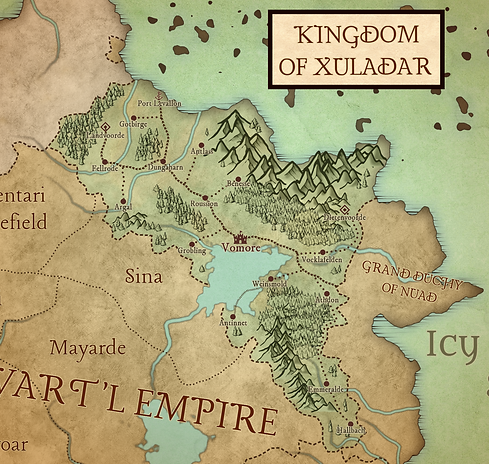
Kingdom Of Xuladar
The Kingdom of Xuladar is a land of awe and storm, where titanic structures pierce the sky and the very air hums with raw, unrestrained energy. At its heart reigns the mythic dragon-king Xeondaris, a colossal wyrm of living lightning and impossible intellect, who is said to have forged the kingdom himself from storm, stone, and sovereign will. Whether Xeondaris is truly a god, a draconic archmage, or something stranger still, none can say for certain—but all agree: he rules.
Xuladar is a free land, not bound to any empire, and yet it holds the might to rival them all. Its people live beneath the crackling sky in cities carved from storm-tempered stone, crystaline towers crowned with arcane conductors, and fortress-halls lined with lightning-fed forges. The kingdom is a haven for stormcallers, engineers, sky-knights, and spellwrights—those who embrace innovation, strength, and the will to endure.
The military of Xuladar, known as the Tempest Vanguard, is a force of terrifying discipline and power—wielding war-golems, stormforged armor, and skyships powered by arcane lightning. It is said that when the drums of war beat in Xuladar, the sky itself darkens in reverence.
Despite its might, the kingdom is not expansionist. Xeondaris, while feared, is known as a just and watchful ruler, allowing his people freedom under a system of noble houses and civic guilds, so long as loyalty and order are maintained. Intrigue exists, as in all great realms, but treason is punished with lightning swift and final.
Population: Mostly Pryad, some Human, some Draconian, partly Hybrid, little Orc, little Arachnari. Monster lineages are shown caution.

The Gray Isles
Scattered across the southern fog-bound seas, the Gray Isles are a ragged chain of rocky, storm-bitten isles where no king holds sway, and the only law is the one written in salt, steel, and smoke. Here, the age of piracy never ended—it simply dug in, dropped anchor, and thrived.
Each isle is ruled by its own warband, fleet-lord, or sea-blooded matron, united under no banner save the whispered respect for the Free Council, a volatile meeting of pirate captains that only convenes when threatened by foreign powers—or when there's gold worth killing for. The waters around the Gray Isles are treacherous, not just for their reefs and storms, but for the corsairs and raiders who strike without warning and vanish into the mists.
Amidst this tide of cutthroats and smuggling coves, one people have endured longer than all: the Honu, a reclusive tribe of turtlefolk whose wisdom runs as deep as the ocean trenches. Dwelling mostly on the western isles, the Honu live in harmony with the tides and wield ancient knowledge of currents, storms, and spirits of the deep. Though peaceful by nature, they are far from defenseless—when roused, they wield spears of pearlstone and tidal rites that can shatter hulls or calm tempests.
The Honu maintain a fragile relationship with the pirates—sometimes guides, sometimes healers, sometimes protectors of sacred reefs the pirates dare not touch. But those who harm a Honu or defile their waters find themselves cursed, lost at sea, or pulled into the deep by unseen hands.
The Gray Isles are a realm of hidden treasures, whispered curses, and cutthroat freedom, where ships fly false flags, ancient wrecks dot the seafloor, and sea shanties carry warnings as often as welcomes.
Population: Mostly Honu, some Human, some Syreni, partly Sauri, partly Gort, little Elf, little Dwarf, little Gnome. Monster lineages are shown caution.
The Everfrost
At the northern edge of the known world lies the Everfrost—a realm of endless winter, where time itself seems frozen beneath a sky of pale fire and constant storm. Shrouded in ceaseless blizzards, white-out gales, and sub-zero nights, this land was once fertile and wild—until a cataclysmic act of sorcery cursed it for eternity.
Legends speak of a mage so powerful and vengeful that he sundered the skies and shattered the seasons, casting an unending frost upon the land as both punishment and prison. The spell, woven with hate and desperation, still holds to this day, and none have been able to undo it. The magic is too deep, too old, too bitter.
What survives in the Everfrost does so with unyielding strength. Ice-bound ruins peek from glacier-cracked cliffs. Frozen forests groan under the weight of centuries. And beyond the treacherous Everfrost Pass, at the edge of the world, monsters—ancient, massive, and hungry—lurk, unable or unwilling to break through the unnatural storms that cage them.
Standing vigil at the mouth of that pass are the Frostguard—an elite brotherhood of warriors, rangers, and ice-magi sworn to defend the warmer world from what lies beyond. Clad in enchanted furs and wielding weapons blessed by cold itself, they are grim, disciplined, and unflinching. It is said they do not age, and that their souls are bound to the storm.
The Everfrost has no king, no cities—only survivors, scattered in insulated outposts or deep-buried holds. The land offers no mercy and demands no allegiance, only endurance. To some, it is a prison. To others, a proving ground. And to a rare few—home.
Population: Mostly Human, partly Elf, partly Dwarf, partly Orc, partly Vargheist, little Lowenar, little Minotaur, little Pryad, little Draconian. Monster lineages are attacked and killed.
